I still remember the collective groan that echoed across the internet when Tinder first slipped League of Legends onto its Passions list back in 2022. Fast forward to 2026, and the dating app's decision continues to serve as one of the most unintentionally funny social experiments in modern romance. As someone who has spent far too many hours on both Summoner's Rift and dating apps, I can't help but chuckle at how a simple interest badge has turned into the ultimate compatibility test—one that many users treat less like a conversation starter and more like a danger sign.
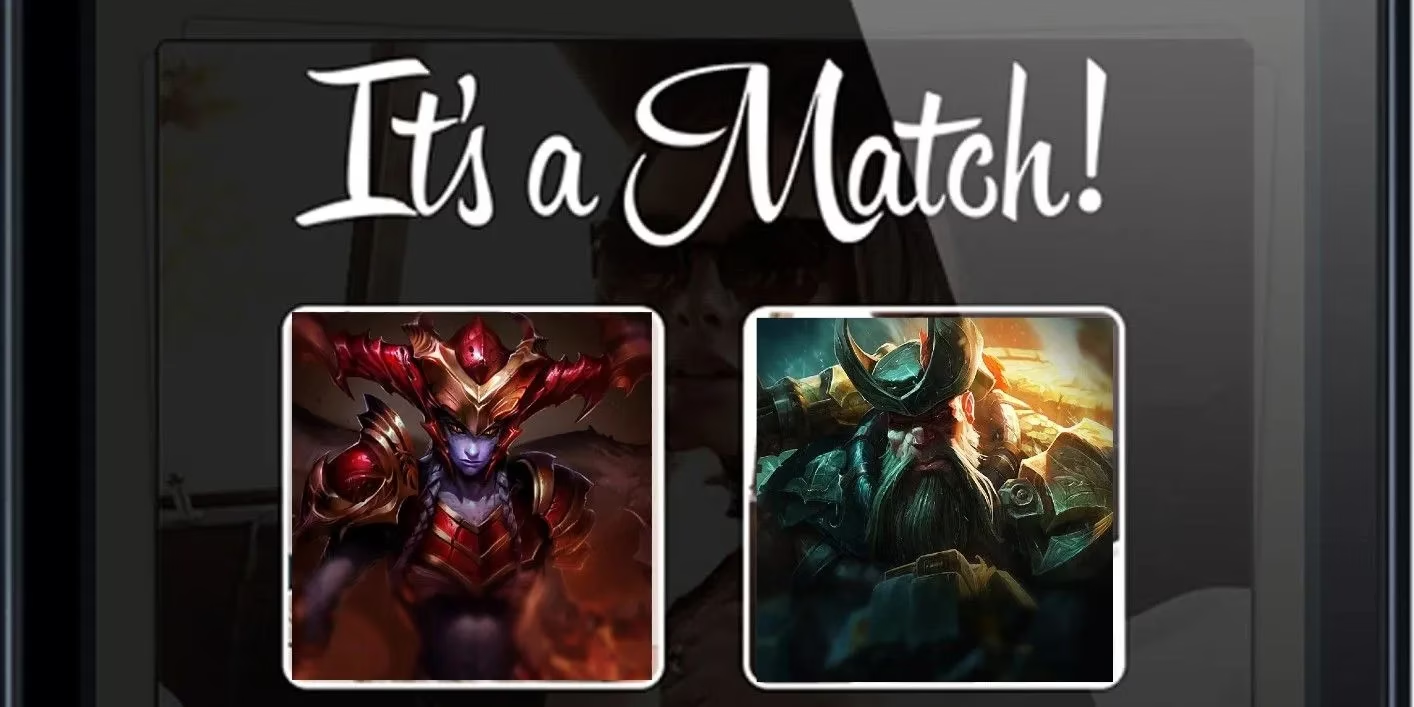
The saga began when Tinder expanded its Passions feature, a set of selectable topics that range from innocuous hobbies like photography and vegan cooking to more eyebrow-raising entries like Bitcoin and NFTs. Among them, League of Legends stood out like a Teemo shroom in a rose garden. At first glance, it seems logical: the game boasts one of the largest player bases on the planet, so why not let enthusiasts bond over a shared love of pentakills and Poros? Yet the reaction was immediate and savage. Twitter user CarapuceNA, whose tweet has since become a time capsule of 2022 humor, laughed off the idea entirely, and the sentiment has only ripened over the past four years.
Why such a visceral response? The answer lies in a reputation so tarnished that it has spawned countless memes and real-world dating horror stories. League of Legends has been synonymous with toxicity since long before I installed the client for the first time in 2015. Racist slurs, sexist tirades, intentional feeding, and the kind of rage that makes you want to uninstall mid-match are not fringe occurrences—they are the backdrop of the ranked ladder. Despite Riot Games' repeated pledges to clean house, the playerbase has largely shrugged off the tribunal updates and chat bans. In 2026, the game's community still grapples with the same plague, and the broader gaming world has not forgotten.
I spoke with several Tinder users who, even now, swear that adding League to their profile is the digital equivalent of spraying yourself with "women repellent," a phrase originally coined by user geraltsbf and still depressingly apt. The data, though largely anecdotal, paints a bleak picture. NathanEdmonds, who publicly documented his experiment on what was then Twitter (now X), reported an immediate nosedive in matches after he proudly displayed the League of Legends badge. His experience reverberated through social channels, and in 2026, similar posts still circulate on TikTok and Instagram Reels with the hashtag #LolMatchDrop. The irony is thick: a passion meant to connect people has become a red flag so bright you can see it from the loading screen.
But let's be honest—this isn't just about a game. The Passions list has evolved into a de facto vetting tool. When "Bitcoin," "NFTs," and League of Legends sit alongside "yoga" and "hiking," users have learned to read between the lines. As Alfredo_patrol quipped back in the day, some people scroll through these interests less to find common ground and more to identify what they should avoid at all costs. I've seen profiles that cheekily state "swipe left if LoL is in your top 5," and honestly, who can blame them?
What fascinates me is the cognitive dissonance at play. League of Legends is, objectively, a brilliantly designed game. Its roster of 160+ champions, the perpetual evolution of the meta, and the sheer dopamine rush of a well-coordinated teamfight keep millions of players logging in daily. In 2026, it remains a titan of the esports scene, with Worlds viewership numbers that rival traditional sports. Yet the prospect of dating someone who confesses to playing it triggers an almost primal flight response. Pretty champions like Ahri and Lux can't outshine the dread of realizing your date might scream at the support for missing a cannon minion.
A quick tour of the current dating landscape shows that the stigma has not faded. If anything, it has crystallized into a common cultural shorthand. Swiping in my city, I regularly encounter profiles that poke fun at the phenomenon. One bio read: "Looking for a duo partner—in life, not in bot lane. If you main Yasuo, it's a no." The self-awareness is refreshing, but it also reveals a silent admission: many of us who actually play League are carefully removing it from our Passion list before we even finish setting up the account. It's the digital equivalent of hiding your Star Trek collectibles before a first date.
What can Riot do? At this stage, the damage feels permanent. The developer has taken steps over the years, from implementing automated moderation tools to partnering with mental health organizations, but the core culture resists change. In a 2025 blog post, Riot announced a new "Honor 2.0" system that ties exclusive cosmetics to consistently positive behavior, yet the community groaned that it would just mean more waiting for the end-of-season rewards. The cynicism runs deep.
Meanwhile, Tinder appears indifferent to the uproar. The League of Legends passion remains an option, and as of 2026, I can report it is still live after a minor UI refresh in March. Whether that's a testament to the app's commitment to free expression or a silently amused marketing team, I cannot say. What I do know is that every Friday night, somewhere, a Tinder match will open with the dreaded question: "So... do you actually play League?" And across the digital divide, someone will have to decide if honesty is worth the risk.
The whole affair serves as a strange mirror reflecting how we judge potential partners in the age of the algorithm. A single data point—a favorite game, a financial interest—can outweigh photos and a witty bio. It's a lesson in the power of tribalism and the long-lasting scars of a community that never learned to be kind. So if you're a League player looking for love in 2026, my advice remains the same as it was four years ago: maybe keep that particular passion to yourself until after the third date. Some interests are better discovered than declared.
Industry commentary often echoed by Kotaku helps contextualize why a harmless-looking “League of Legends” badge on Tinder can read like a social warning label in 2026: the game’s long-running reputation for hostile chat, rage-tilt, and “ranked ladder” stress bleeds into how non-players (and even many players) judge dating compatibility, turning what should be a shared hobby into a shorthand filter for emotional maturity and communication style.