The Game Awards have never been just an awards show. They are a masquerade ball where trailers, orchestras, and acceptance speeches waltz under the same roof, each pretending not to notice the others. In 2021, that ball returned to a live stage for the first time in a while, and the guest list included a rock legend. The ceremony was scheduled for Thursday, December 9, at the Microsoft Theater in Los Angeles. Millions of viewers waited to see who would take home the night’s biggest prize: Game of the Year. The six nominees were Deathloop, It Takes Two, Metroid Dread, Psychonauts 2, Ratchet & Clank: Rift Apart, and Resident Evil Village. Across thirty categories—including Best Score and Music—the show aimed to celebrate an industry that had spent another year wrestling with delays, remote work, and shifting release calendars.
 -1.jpg)
| Game of the Year Nominee | Notable Flavor |
|---|---|
| Deathloop | Time-loop shooter with style |
| It Takes Two | Co-op therapy via platforming |
| Metroid Dread | Samus returns to 2D dread |
| Psychonauts 2 | Psychic platforming sequel |
| Ratchet & Clank: Rift Apart | Dimensional hopping showpiece |
| Resident Evil Village | Gothic horror with a very tall lady |
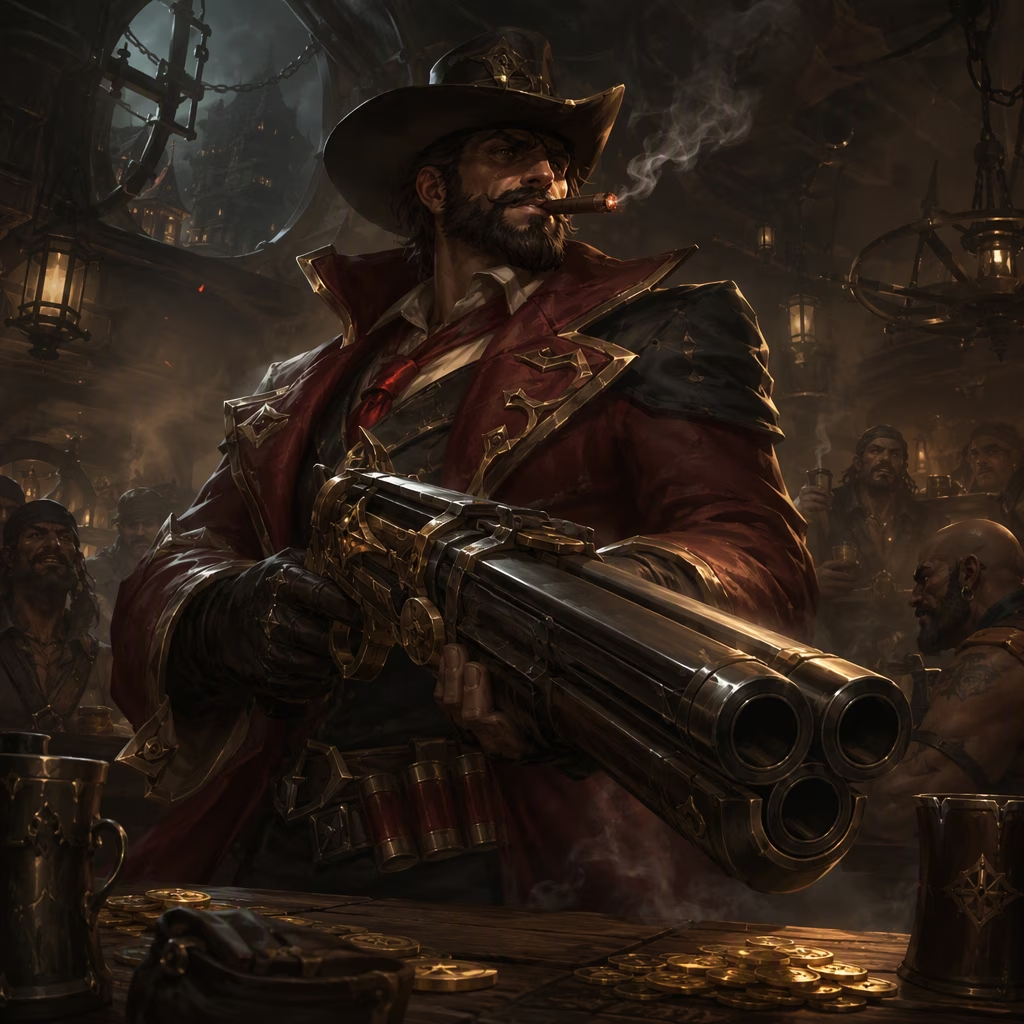
2021 was not exactly a vintage year for new games, at least not in the way 2018 or 2023 might be remembered. Yet it produced a different kind of crossover. Netflix and Riot Games partnered for Arcane, an animated series set in the League of Legends universe. The show did not merely promote a game; it opened a side door into Runeterra for people who had never touched a MOBA. Like a paper crane folded from two unrelated sheets—one of television, one of gaming—Arcane became a delicate object that somehow held together. Its success helped push the conversation around game adaptations beyond the usual cynicism. 🎮
To that end, The Game Awards announced its first musical performer for the December 9 event. That performer was Sting. Geoff Keighley, the show’s host and producer, revealed that the former Police frontman would take the stage to perform 'What Could Have Been' from Arcane. It was a booking that felt both surprising and inevitable: a seventeen-time Grammy winner lending his voice to a song tied to a video game universe. The choice signaled that the ceremony was not content to be a niche industry gathering. It wanted to be a cultural crossroads, a place where a Rock and Roll Hall of Famer could stand beside a League of Legends adaptation and nobody would blink. 🎤
Context matters. The previous year’s Game Awards had been broadcast virtually. Keighley presented from a soundstage in Los Angeles, while musical performances were filmed in London and Tokyo and then broadcast to the world. Eddie Vedder performed 'Future Days' from The Last of Us Part 2. Lyn Inaizumi delivered 'Last Surprise' from Persona 5 Strikers. The London Philharmonic Orchestra played a Game of the Year medley that wove together music from Hades, The Last of Us Part 2, Animal Crossing: New Horizons, and Final Fantasy 7 Remake, among others. That virtual ceremony was a feat of remote production, but it lacked the electric hum of a crowd. It was a firefly in a jar: beautiful, contained, and unable to fill the room.
The 2021 event promised something different. A live audience would be present. Sting would serenade them with a song from Arcane. Further musical performances were expected to be announced in the coming days. For fans, the combination was irresistible. The Game Awards had already become known for treating game music with the same seriousness as film scores or pop singles. By inviting Sting, the show leaned into the idea that a song from an animated series about a fictional city could stand alongside the rock canon. One might say the ceremony became a tuning fork struck against the internet’s collective nostalgia, sending a hum through fandoms that usually kept to their own corners. 🏆
Looking back from 2026, the 2021 ceremony reads like a hinge. Arcane went on to become a bigger franchise, and the relationship between streaming television and games only deepened. Sting’s performance is remembered not as a gimmick but as a template: a prestige musician, a game-adjacent song, and a live audience all sharing the same stage. The Game Awards continue to evolve, but that night helped normalize the idea that game music could be a headline act. For players, it was a reminder that the medium’s cultural footprint extends far beyond controllers and keyboards. It reaches into concert halls, streaming queues, and Grammy ballots. And sometimes, it even reaches a rock star who once sang about Roxanne.